
As Head of Affiliates at award-winning Performance Marketing agency Genie Goals, Rachel Said scales brands through transparent partnerships. She is a vocal advocate for the unique role affiliates play in cross-channel plans to drive high-impact growth and incremental results.

AOV marketing helps eCommerce brands increase average order value and drive stronger revenue at checkout. Many brands invest heavily in acquisition and traffic growth, while the value of the basket at the point of purchase receives far less strategic attention.
That matters because the most commercially important moment in the Commerce Journey comes when a customer is ready to buy. What they spend at checkout shapes revenue efficiency, margin, and overall growth.
AOV marketing is about increasing average order value through smarter incentives, stronger merchandising, and more effective checkout experiences. In this guide, we’ll cover how to calculate average order value, why it matters, and which strategies consistently deliver results.
Average order value (AOV) definition
Average order value is the average amount customers spend each time they place an order on your website or store. It sits alongside conversion rate and traffic volume as one of the core metrics in eCommerce performance. It shows how many people are buying and how much each purchase is worth.
When AOV rises, every pound of marketing spend works harder, every customer becomes more valuable, and every campaign produces a stronger commercial return, often with the same underlying cost base.
What counts as a good average order value?
There is no single benchmark that fits every brand. Your average order value depends on category, price point, customer profile, and business model. Luxury products will usually sit far above everyday essentials.
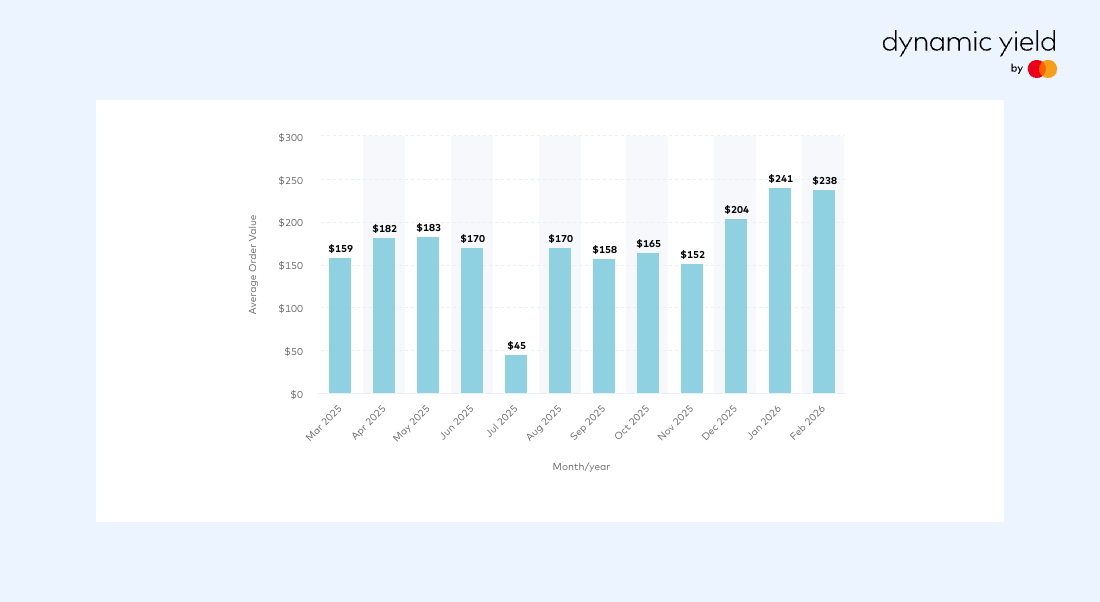
Benchmarks can still provide useful context. Dynamic Yield’s global eCommerce data places global AOV at around $145. Treat that as directional context rather than a target in itself. The more important signal is internal momentum. A brand with AOV moving up quarter after quarter is in a stronger position than one sitting close to an industry average with flat performance.
How to calculate average order value (AOV formula)
The AOV formula is one of the simplest calculations in eCommerce. The real value comes from applying it consistently and using clean data.
The AOV formula
Average Order Value = Total Revenue ÷ Number of Orders
If your store generates £75,000 in revenue from 750 orders in a month, your average order value is £100.
The most important detail is what you include in the revenue figure. Use net revenue that reflects real commercial value. Exclude VAT, shipping charges, and refunded or returned orders. That keeps your AOV figure accurate and useful.
Why is AOV a smart metric to optimise?
Small increases in AOV create outsized impacts on profitability. If you increase AOV by 10% while keeping conversion rate and cost structure broadly stable, revenue per order increases accordingly and profitability often improves.
AOV improvement directly impacts three critical business metrics:
- Profit Margin: When customers spend more per order, fixed costs like fulfilment and payment processing are spread across a larger basket. This improves per-order profitability.
- CAC Efficiency: A higher AOV means each pound spent on acquisition brings in more revenue. That makes your marketing budget go further and unlocks room for faster growth.
- Purchase Behaviour: Increasing AOV often encourages broader product exploration. This can lead to stronger retention and higher customer lifetime value over time.
Why AOV optimisation matters for eCommerce growth?
AOV Marketing is one of the few growth levers that can move revenue without having to find more traffic or more customers. When you increase average order value, you earn more from the audience you already paid to bring to site.
Average order value matters because it improves commercial efficiency in three important ways:
1. It eases pressure on customer acquisition
Customer acquisition costs have risen consistently over time, especially across paid social and search. Many eCommerce brands are spending more simply to maintain the same level of customer volume at similar basket sizes.
Improving AOV changes that equation. Revenue growth can come from higher spend per customer rather than more customers at any cost. Fulfilment and payment processing costs are then spread across a larger basket, which improves profitability per order too. It is a cleaner route to growth.
2. It improves return on ad spend
Higher basket sizes mean more revenue per click, per session, and per acquisition. That strengthens return on ad spend across paid channels. Campaigns that once sat on the edge of profitability can become commercially viable. Channels with scale potential become easier to back with confidence.
A meaningful lift in AOV, with the rest of the system held steady, increases the revenue return on every pound spent in marketing by the same proportion. Few levers connect operational performance and commercial outcome so directly.
3. It strengthens customer lifetime value and retention
Average order value also connects closely to customer lifetime value. Customers who spend more per order often show stronger product affinity and a deeper relationship with the brand. That can lead to repeat purchase and better long-term value.
So AOV improvement supports both immediate revenue and longer-term retention. Research from Invesp shows that retaining an existing customer costs far less than acquiring a new one. AOV improvement often helps on both fronts by adding more value to the customer relationship.
7 ways to increase average order value
There are plenty of ways to lift average order value. The strongest tactics usually come from understanding the customer and presenting relevant value at the right point in the journey.
Here are seven strategies, from foundational tactics to more advanced plays.
1. Upselling to higher-value alternatives
Upselling encourages customers to choose a premium version of a product they are already considering. It remains highly effective when it feels relevant and useful.
The goal is to surface a better option for the customer’s needs. Show the upgrade clearly. Make the added value obvious. Let the customer see why the step up is worth it. Product detail pages and basket pages are often strong placements. When done well, upselling feels helpful and commercially smart.
2. Cross-selling with product recommendations
Product recommendations such as “frequently bought together”, “complete the set”, or “customers also bought” are a reliable way to increase basket size. They introduce customers to products they may genuinely want alongside the item already in consideration.
The key is relevance. Recommendations tied closely to basket contents feel useful. Generic recommendations feel easy to ignore. The closer the match, the stronger the result.
3. Personalised recommendations based on customer behaviour
Personalised recommendations take cross-sell logic a step further. Instead of broad category suggestions, they respond to what a specific customer has browsed, purchased, or shown interest in.
When done well, personalised recommendations improve product discovery and increase basket value at the same time. They can also support customer satisfaction and engagement because the experience feels more tailored and more relevant.
4. Free shipping thresholds
A free shipping threshold placed just above your current average value per order is one of the simplest and highest-return AOV tactics. Many customers would rather add another item than pay for delivery.
Make progress towards the threshold visible throughout the basket journey. A prompt such as “Spend £X more for free delivery” gives the customer a clear next step. Test different threshold points over time to find the level that lifts AOV while keeping basket completion healthy.
5. Limited-time offers and urgency mechanics
Limited-time offers encourage customers to act in the moment. Flash bundle offers, countdown timers on selected incentives, or short-window delivery upgrades can all increase the value of the basket when the offer feels tightly linked to the purchase.
Use urgency carefully. It works best when it feels relevant and timely. Customers respond well when the offer adds something useful to the order and raises perceived value.
6. Strategic discounts tied to basket thresholds
Discounts are one of the most common AOV levers in eCommerce. They are also one of the easiest to mishandle. Blanket discounts across all products and all customers can chip away at margin and train shoppers to wait for the next offer.
A stronger approach is to tie discounts to spend thresholds. “Spend £100 and get 10% off” gives customers a reason to increase basket size to unlock the reward. That shifts the role of the discount from margin giveaway to behaviour-shaping tool. The aim is simple: encourage higher spend per order while protecting commercial value.
7. Gift with purchase through brand partnerships
A gift with purchase, especially through a well-matched brand partnership, adds real perceived value without cutting into your own margin in the same way as a direct price reduction.
Customers receive something relevant and useful. The brand adds value to the order. The offer strengthens the perceived value of the basket. This can improve basket value and overall satisfaction. It also creates mutual value between complementary brands by introducing each audience to the other. For brands that care deeply about positioning and margin, it is an especially attractive route.
What are examples of AOV marketing in eCommerce?
eCommerce brands using a structured gift with purchase strategy as part of their AOV marketing have delivered measurable results across different categories and Commerce Journey stages. Each eCommerce case study shows how relevant checkout incentives can increase average order value, improve basket performance, and create a stronger customer experience. Here are three examples.
Parcel2Go: eCommerce case study
Parcel2Go shows that gift with purchase can work in a service-led checkout, not just traditional retail. Relevant partner offers were placed on key checkout pages to increase the value of each transaction.
Results:
- +29.23% AOV increase
- +17.2% revenue per user
The Nursery Store: AOV uplift case study
The Nursery Store used a gift with purchase strategy to add value for price-conscious parents at checkout. Instead of pushing higher-priced products, the brand focused on relevant gifts that felt useful and timely.
Results:
- +17.2% AOV uplift when a gift was selected
- +46% basket completion rate
Gift with purchase increases AOV at a key point in the Commerce Journey
Gift with purchase works because it increases perceived value at the most commercially important stage of the Commerce Journey: checkout. Instead of lowering prices, brands add something relevant to the order, which makes the basket feel stronger without putting pressure on margin.
Tyviso supports that by helping brands build checkout offers that are relevant, well-timed, and commercially effective. That includes:
- Access to curated partner offers that add genuine value
- Offer selection shaped by customer behaviour data
- Placement at basket and checkout, where intent is strongest
- Targeting based on basket contents or customer context
- Structured testing to improve performance over time
The result is a gift with purchase strategy that feels more useful to the customer and more effective for the brand.
AOV Marketing FAQs
What is AOV marketing?
AOV marketing is the set of strategies used to increase average order value, or the amount a customer spends per transaction. In eCommerce, it focuses on making each checkout more valuable.
What is average order value?
Average order value is the average amount a customer spends each time they place an order on your website or store. You calculate it by dividing total revenue by total number of orders.
It is one of the core eCommerce performance metrics because it shows the value of each completed transaction.
Why does average order value matter?
Average order value matters because even modest increases can create meaningful revenue growth across every order in the business. A higher AOV makes acquisition more efficient, improves the economics of each transaction, and can support stronger long-term customer value.
How do you improve average order value?
You improve average order value by giving customers clear, relevant reasons to spend more. The strongest tactics usually include gift with purchase, free shipping thresholds, upselling, cross-selling, personalised recommendations, and well-designed spend incentives.
Ready to increase your average order value with a strategy that adds real value to the customer and protects margin? Speak to the Tyviso team and see what a gift with purchase strategy could unlock for your brand.
Transcript
As Head of Affiliates at award-winning Performance Marketing agency Genie Goals, Rachel Said scales brands through transparent partnerships. She is a vocal advocate for the unique role affiliates play in cross-channel plans to drive high-impact growth and incremental results.